
Pale oak is pigment next to a loud solid
Pale oak is a second colour beside Tristone, not a backdrop. Check grain, oil and ratio so the saturated worktop stays loud and the timber stays supportive.
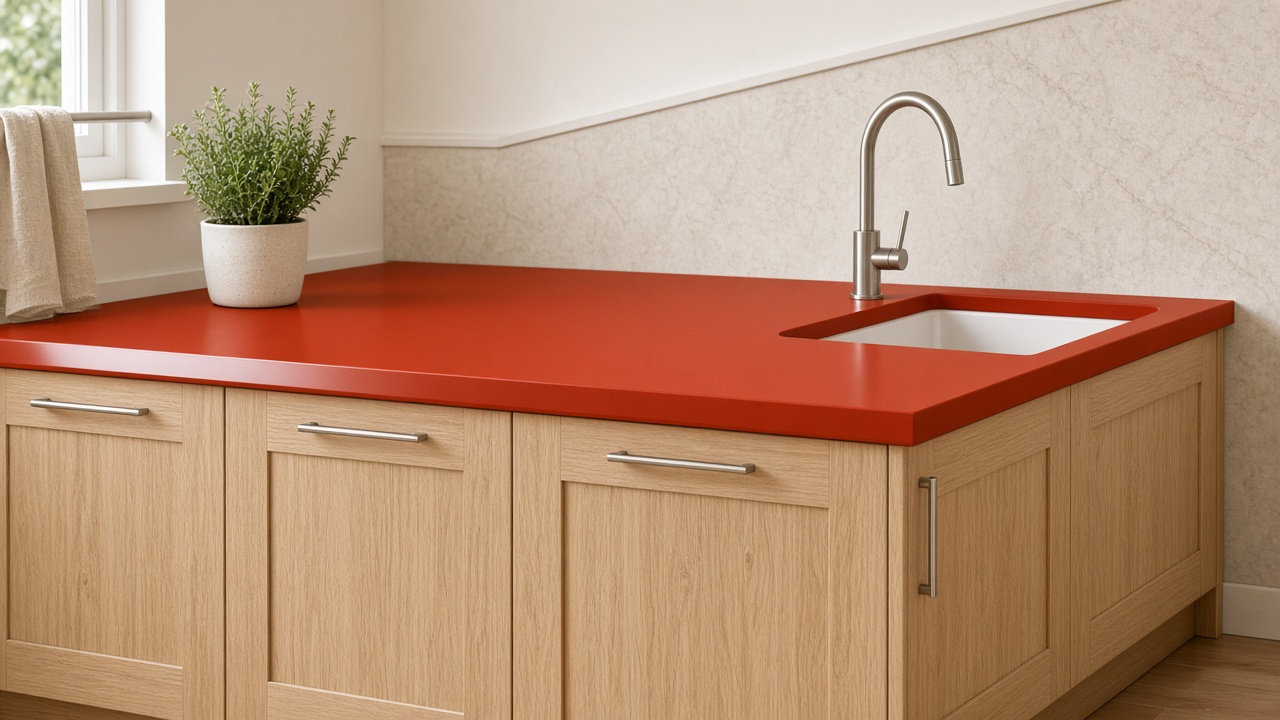
The moment pale oak meets a saturated Tristone solid, you have two colours on the bench, not a colour and a neutral. Washed oak is yellow, pink or faintly green depending on the board and the oil. That undertone will rewrite terracotta, forest green and icy blue at the junction. Tristone Worktops UK asks you to choose the timber as carefully as the slab, then give the loudness to only one of them. Pale oak is a supporting pigment. It is not beige paint in wooden form.
Read the junction, not the brochure
People reach for pale oak because they want warmth without walnut gloom. That instinct is sound, but oak is chromatic. Fresh oil leans honey. A limed or white-pigmented board leans grey-pink. White oil can shove green Tristone towards teal and can make icy blue look clinical. Choosing the worktop first and the timber later, as if the oak were a backdrop, is how dirty meeting lines happen.
Lay the Tristone sample on the actual boarded door or on a leftover floor plank. Look at that junction in daylight and again under the LEDs. The eye reads the seam more than it reads either material alone. If the seam looks soiled, the undertones are fighting, and no bowl of fruit will hide it once the run is fitted.
Give loudness to one plane
Saturated Tristone should own a single plane. Pale oak can own the verticals or the floor, not both, unless the worktop is a quiet cream. Two timber planes plus a terracotta island starts to look like a chalet. One timber plane plus a forest-green run looks considered. Spend the loudness budget on the solid.
- Oak doors with a saturated worktop and a pale painted floor, or a pale stone-look tile.
- Painted cream doors with a saturated worktop and pale oak flooring: the more domestic British layout.
- An oak breakfast table against a Tristone run, provided the table is not as saturated as the slab.
- Skip oak open shelves stacked with terracotta crockery if the worktop is already terracotta.
Grain and oil will shift the solid
Wide-grain pale oak throws linear texture. Beside an even Tristone solid that texture is useful, because it stops the worktop looking like plastic, but only if the grain is not orange. Orange grain beside terracotta is two warm louds in a quarrel. Cooler, flatter oak beside terracotta is the pairing that still feels like home.
Hardwax oils yellow over a year. If you judge forest green against a newly oiled door in March, come back in December before you call the pairing stable. Water-based lacquers yellow less and keep icy blue cleaner. Tell the kitchen maker which Tristone colour is coming; their finish is part of your colour specification whether they list it that way or not. Brass on oak next to green or terracotta is usually a gift. Chrome on oak next to icy blue can look like a laboratory. Match the metal to the warm or cold side of the Tristone, not to a tap catalogue in isolation.
A table test before anyone templates
Put the Tristone chip, the oak sample, a scrap of wall paint and the proposed tap finish on the table at noon and again at dusk. Remove anything that will not be in the finished room. If the oak suddenly looks cheap, the worktop is too saturated for that batch of timber. If the worktop suddenly looks noisy, you have too much oak in shot. Reduce one, not both.
When the four objects still look like a household rather than a showroom bay, ask Tristone Worktops UK to template. Saturated colour beside pale oak is one of the strongest pairings we fit, but only when the timber has been admitted as a colour in its own right.
Next step with Tristone Worktops
Order a sample, then request a fitted quote or browse the worktop collection. The colour should be judged in your own daylight before anyone templates the run.