
Tristone vs Quartz: Which Kitchen Worktop Is Right for You?
Tristone acrylic solid surface and quartz are both popular choices, but they suit different kitchens. Here is how they compare in everyday use.
A terracotta island needs cream cabinets or it becomes a restaurant; these notes are about pairing, not just picking a favourite chip. Tristone Worktops UK writes about colour first — how a saturated solid behaves next to oak, brass and British weather, and when a bold slab should stay the only loud surface in the room.
Tristone and quartz are both low-maintenance, non-porous kitchen worktops, but they are very different materials. Tristone is an acrylic solid surface that can be joined seamlessly, shaped into curves and repaired if it is damaged. Quartz is a hard engineered stone, but its joints stay visible and damage is difficult to put right. For most kitchens, Tristone is the better long-term choice.
This guide compares Tristone vs quartz on looks, joints, sinks, durability, heat, repairs and care.
What is Tristone?
Tristone is an acrylic solid surface manufactured by Lion Chemtech and distributed in the UK and Ireland by Tristone UK. According to Tristone UK, it is seamless, non-porous and resistant to heat, moisture and bacteria, and it can be joined seamlessly and thermoformed, which means it can be heated and shaped into curves. Tristone comes in a range of plain, speckled and patterned colours.
What is quartz?
Here are the kitchen worktop ranges we currently supply:
Quartz worktops are engineered stone, made mainly from crushed quartz bound with resin and pigments and pressed into slabs. The result is a very hard, dense surface with the look of polished stone. Quartz is cut from slabs, and pieces are joined with tight, colour-matched joints rather than seamlessly bonded.
Tristone vs quartz compared
Appearance
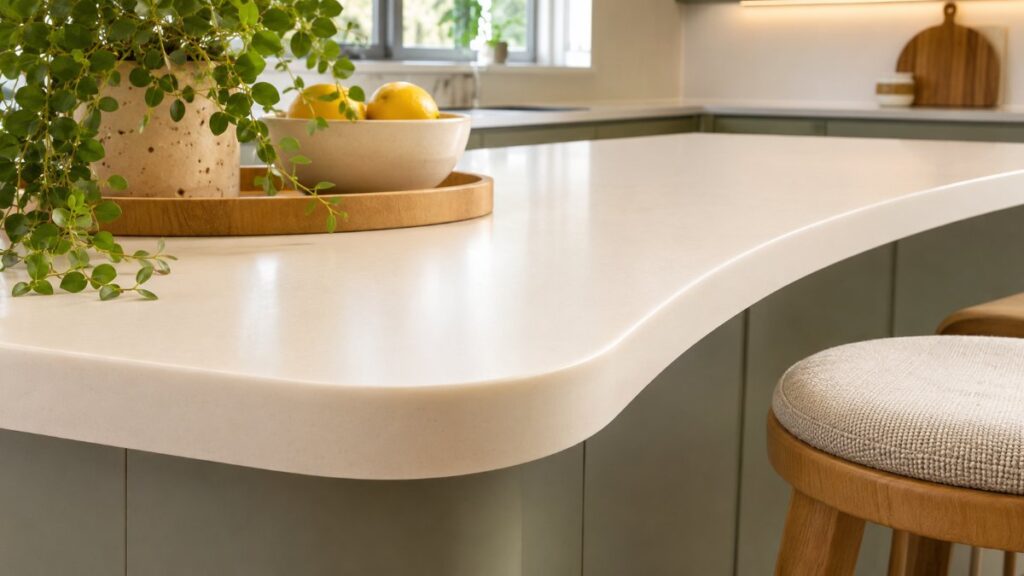
Quartz is known for a crisp, polished stone look, with many marble-effect designs. Tristone has a smooth finish and a calm, contemporary look, with colours that work especially well across long runs and islands because there are no obvious breaks. If you want curved edges or flowing shapes, Tristone can be thermoformed; quartz cannot.
Joints
Tristone joints are bonded and polished so that they are very hard to spot. An L-shaped run or large island can look like one piece. Quartz joints are neat when well made, but you will still see a line, particularly on pale or veined colours.
Sinks
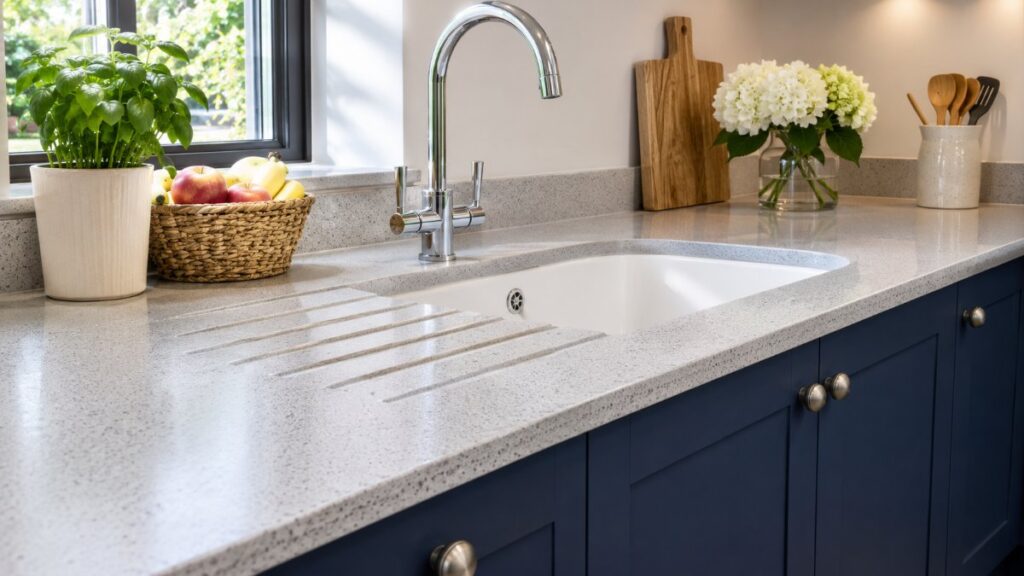
Tristone can be paired with an integrated solid surface sink, bonded into the worktop for a seamless finish with no rim to clean around. Quartz is usually paired with an undermount or inset sink, so there is always a join between worktop and bowl.
Scratches and everyday wear
Quartz is a harder surface, so it is less likely to pick up fine scratches. Tristone is durable but can show fine marks in busy areas over time, and Tristone UK’s care guidance is clear that you should not cut directly on the surface and should always use a chopping board. Unlike quartz, those marks can be repaired, as explained below.
Repairs
This is Tristone’s biggest advantage. As Tristone UK’s care guidance puts it, unlike most other work surfaces, solid surface can be repaired. Minor scratches and stains can be treated, and a professional can repolish the whole surface or fill and blend chips. Quartz chips can be filled, but repairs are usually more noticeable.
Heat
Neither material should be used as a pan stand. Tristone UK advises always using a hot pad or a trivet with rubber feet and avoiding temperatures above 80°C. Quartz also contains resin and should be protected from direct heat. With either material, keep trivets next to the hob and oven.
Hygiene and stains
Both materials are non-porous and do not need sealing. Tristone’s seamless joints and integrated sink option mean fewer edges and gaps where dirt can collect. With either surface, wipe up spills promptly.
Cleaning
Both are easy to clean day to day. For Tristone, Tristone UK recommends a solid surface worktop cleaner and a microfibre cloth, and advises keeping strong chemicals such as paint removers and oven cleaners away from the surface. If they are spilled, flush the area with water promptly.
Installation
Both need professional templating, fabrication and fitting. Quartz slabs are heavy and cut in a workshop. Tristone is fabricated for your kitchen, with joints bonded and finished to blend in.
Large islands and breakfast bars
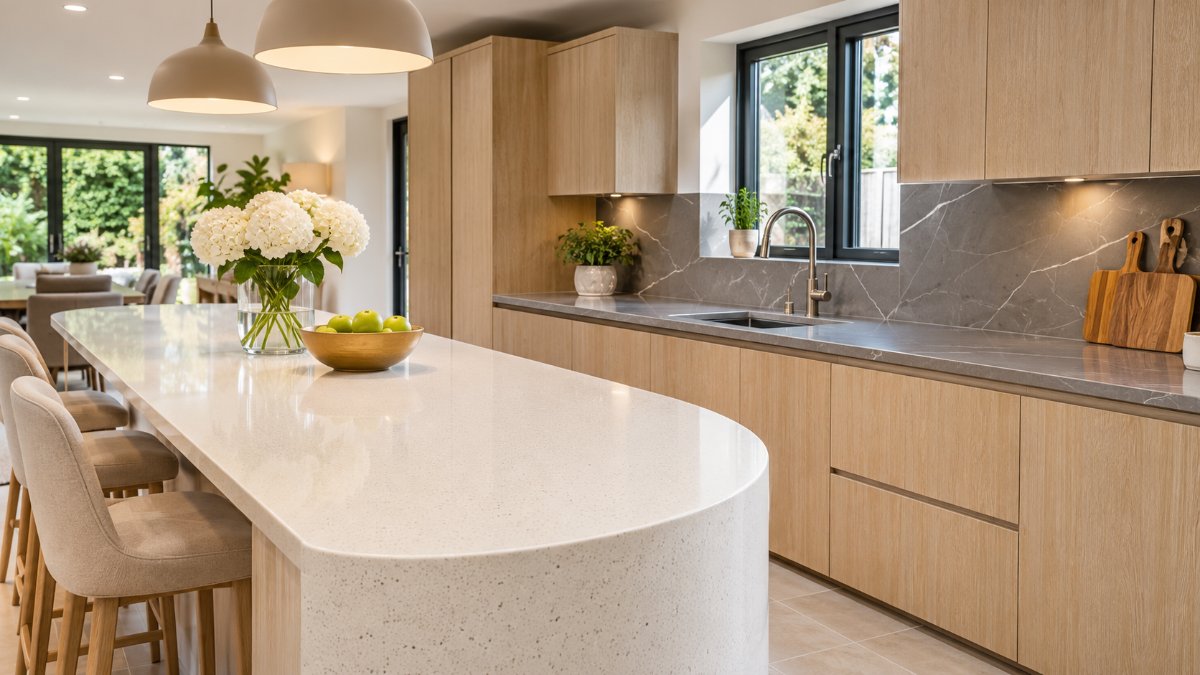
Big islands show the difference between the two materials clearly. Because Tristone pieces can be joined seamlessly, a large island can be made from several pieces and still read as one continuous surface, with matching upstands and splashbacks if you want them. Quartz islands depend on the size of the slab, so a larger design may need a joint, and it is worth asking where it would fall before you decide.
Which should you choose?
We supply quartz as well, but for most kitchens we recommend Tristone. Quartz is a hard, stone-like surface, but it is cut from slabs with visible joints, it cannot be curved, and when it chips the damage is difficult to put right. Tristone gives you a better-looking finished kitchen and a worktop that can be kept looking new for many years.
Tristone suits you if you want
- Very discreet joints across long runs and islands
- An integrated sink with no rim
- Curved edges or flowing shapes
- A worktop that can be repaired and refreshed over the years
A question of priorities
If you value a seamless look, an integrated sink and the reassurance that marks can be repaired rather than lived with, Tristone is hard to beat. Ordering free samples and living with them for a few days is the easiest way to see the difference for yourself.
And if you already have a solid surface worktop that is looking tired, our repair and repolish service may be able to bring it back without replacing it.
See Tristone in your kitchen
Browse the colours on our Tristone page, order a free sample, and request a quote with your measurements. Our team can talk you through joints, sinks and edge details so you can make the right choice for your home.